
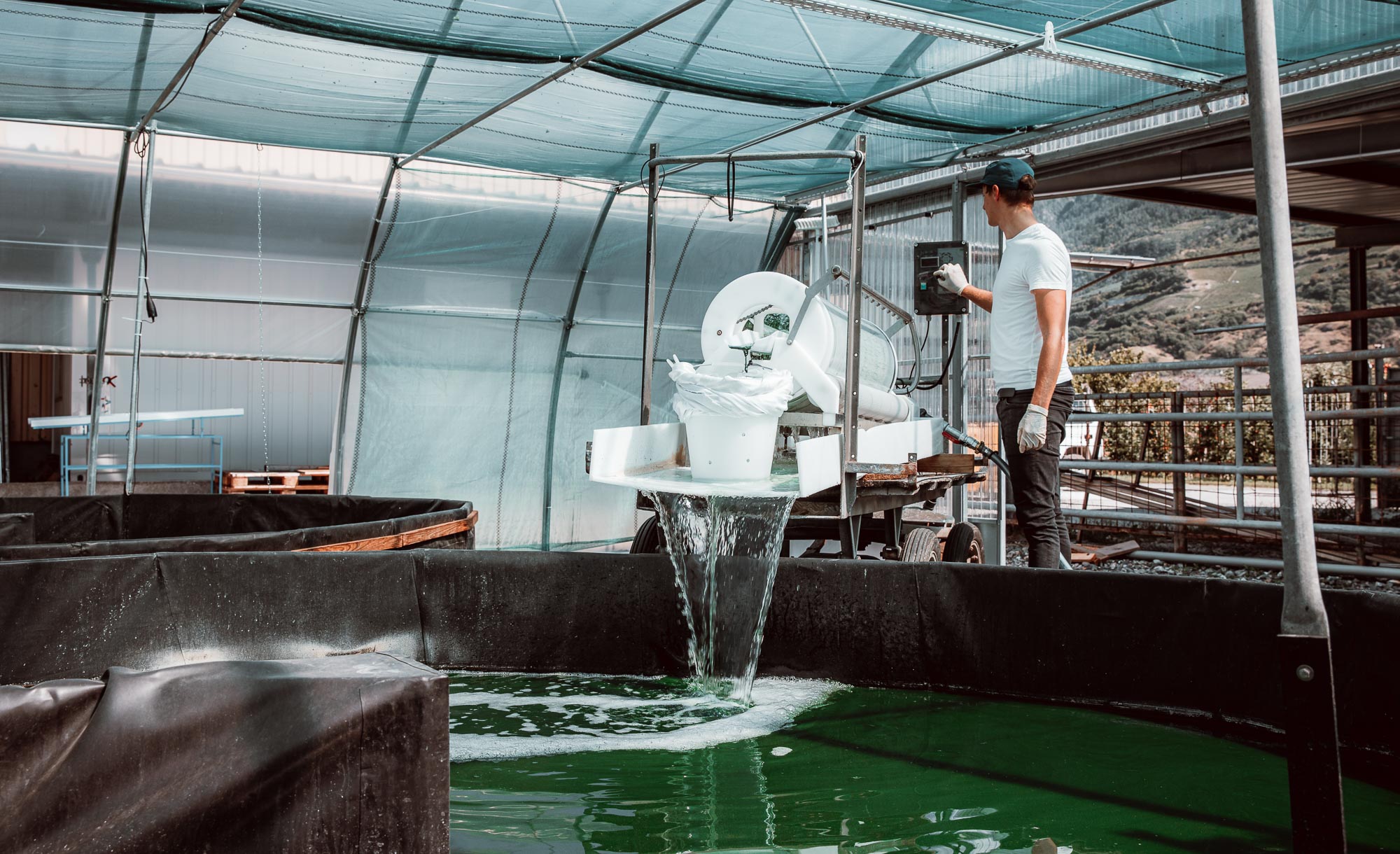
Spiruline-Valais, the ecological spirulina
The benefits of local production
We can never say it enough: eating local is essential — for the quality of the food, for supporting farmers, and for protecting the planet. Yet superfoods are often produced in exotic countries. Spirulina itself is mostly cultivated and imported from abroad. So one might wonder whether it is worth benefiting your health at the expense of the planet’s? What are the alternatives for spirulina?
Well, good news! Valais is an ideal region for this cultivation. Indeed, thanks to the long hours of sunshine our canton enjoys, spirulina soaks up the sun, which stimulates photosynthesis and therefore its growth. We can thus have access to this superfood cultivated directly in our region. This brings many advantages:
- Transparency related to production : here there are no GMOs, no pesticides, 100% natural products — and that we can only love! In addition, the quality of the nutrients is optimal, unlike some ultra-processed spirulina, because it is dried using traditional methods at low temperature. Finally, it is a guarantee that your spoon contains 100% spirulina, without any added binders or other preservatives.
- Support for an innovative cultivation taking its first steps in Valais thanks to the expertise of Robin Dorsaz, trained by the French federation of spirulina growers.
- Support for the local economy: spirulina is sold at a fair price that goes directly to its Valais producers.
An alternative to the current ecological crisis?
Spirulina has a positive impact on our environment for several reasons.
- As we know, intensive farming is a disaster for our planet. On the other hand, our body needs the nutrients found in meat, and more particularly iron, which is precisely very present in spirulina. Spirulina is therefore ideal in vegetarian diets and, on a larger scale, to supplement the diet of anyone who wishes to reduce their meat consumption. In a not-so-distant future, spirulina could be a good alternative for reducing livestock farming.
- Production breaks all records in terms of yields, since that of spirulina is 125 times higher than that of maize and 100 times higher than beef. Let’s make a small comparison between spirulina protein and those of maize and meat (for an identical quantity of protein):
– 30 to 50 times less water used
– 30 to 300 times less land used
The figures speak for themselves, don’t they?
- Growing spirulina does not require the use of fertile soil. It can be grown on unproductive land and in ponds a few centimetres deep (aquaculture). Consequently, spirulina cultivation is ideal, because it does not cause soil erosion. Moreover, no pesticides, herbicides or fungicides are used for the production of spirulina, which is grown off-soil, helping to protect groundwater.
- The destruction of forests remains a major problem today. Conventional agriculture is one of the main causes of this phenomenon. Large spirulina crops could therefore promote optimal reforestation, especially since spirulina is an excellent oxygen producer. Indeed, it is capable of producing 16 tonnes of oxygen per year per hectare, compared with 10 to 15 tonnes for a hectare of forest. At the same time, spirulina is a champion at absorbing CO2 produced by humans: around 30 tonnes per hectare per year, compared with around 9 tonnes for a hectare of forest.
A CO2 collector, an oxygen producer and barely polluting — what more could you ask for?! Might spirulina be THE superfood that would help us take care of ourselves while also taking care of our environment?