
Spirulina is winning over more and more health-conscious people in Switzerland. But one detail changes everything: the vast majority of spirulina sold in Switzerland is imported from Asia, often with limited traceability. Choosing Swiss spirulina, grown locally, isn’t just about patriotism — it’s a choice of quality, transparency and sustainability. Here’s why, and how to recognise good Swiss spirulina.
What is Swiss spirulina?
Spirulina is a microscopic cyanobacterium (also called a micro-algae or blue-green algae) that grows in fresh water and works like a plant through photosynthesis. Considered a superfood, it is naturally rich in plant protein, iron, vitamins, trace elements and antioxidants.
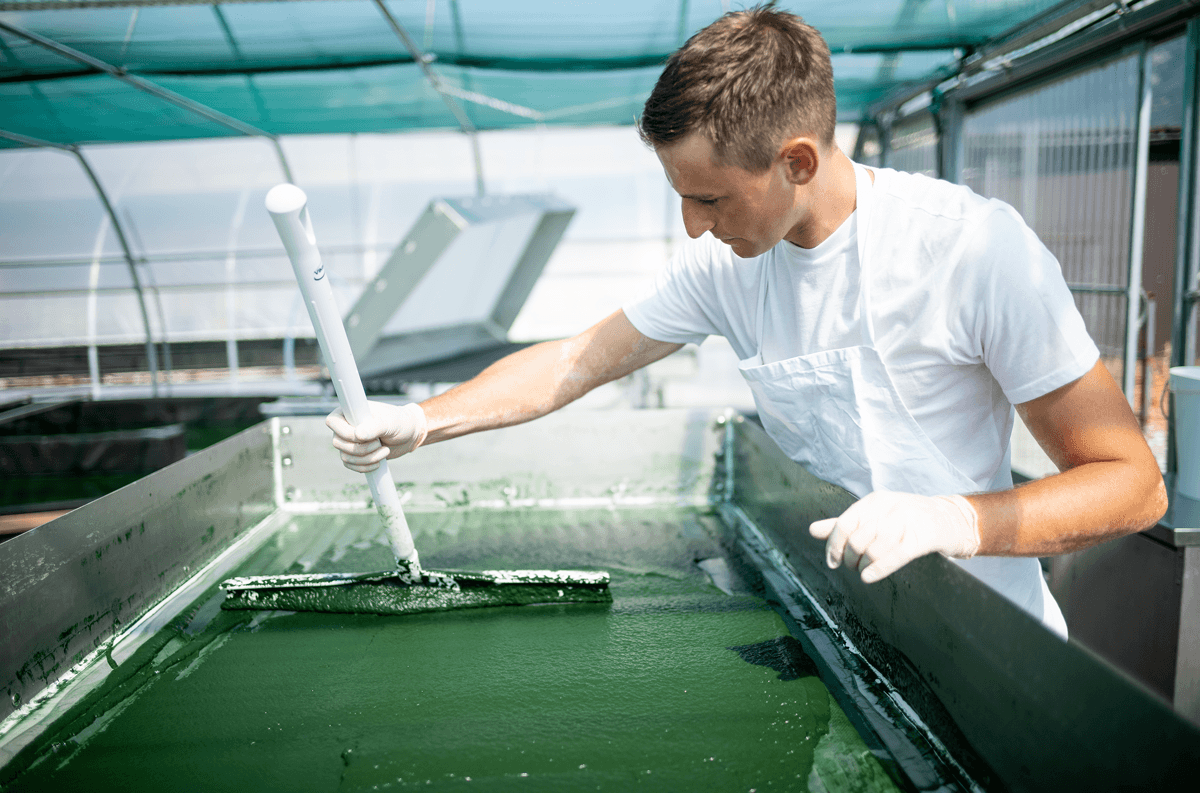
We speak of Swiss spirulina when it is grown and processed in Switzerland rather than imported. That’s our case: our spirulina is produced in Saxon, in Valais, in the heart of the Alps, under controlled conditions from start to finish — traceable from the cultivation pond to your plate.
Why choose Swiss spirulina over imported spirulina?
The difference comes down to three things. First, traceability: Swiss spirulina is monitored and controlled at every stage, whereas imported spirulina travels through long supply chains that are hard to verify. Second, food safety: spirulina is known to absorb heavy metals present in its cultivation water; local, controlled production greatly reduces this risk. Third, sustainability: by buying spirulina from Valais, you favour a short supply chain and avoid the carbon footprint of a product shipped from the other side of the world.
In short: Swiss spirulina gives you the same micro-algae, but with the guarantee of knowing where, how and by whom it was produced.
What are the benefits of Swiss spirulina?
Spirulina is one of the most complete foods there is — the World Health Organisation described it back in 2005 as “the richest and most complete food in the world after breast milk”. Its nutritional strengths are numerous:
- Rich in protein: up to 65% of its weight, with all the essential amino acids — ideal for athletes, vegetarians and vegans.
- A source of iron: a natural ally against fatigue.
- Phycocyanin: its blue pigment, an antioxidant that supports the immune system.
- Antioxidants and provitamin A: for vitality and healthy, radiant skin.
To go further, discover our article on the benefits of spirulina.
How to recognise quality Swiss spirulina?
Not all spirulina is equal. Here are the criteria to check before buying:
- Origin and traceability: an identifiable Swiss producer, with an address and a transparent production method.
- Low-temperature drying: dried at around 40°C, spirulina keeps all its nutrients and its taste. Drying that is too hot destroys part of them.
- No pesticides, herbicides or GMOs: a clean crop, sheltered from outside pollution.
- Heavy-metal testing: essential for safe consumption.
- Flake form: less processed than tablets, a sign of a careful, artisanal process.
Our spirulina from Valais ticks every box: grown under greenhouse from April to October, dried at low temperature and 100% traceable.
Is Swiss spirulina organic and free from heavy metals?
Spirulina grown locally, without pesticides or chemical fertilisers and under close control, offers guarantees that are very close to — or even stronger than — a simple label. At Spiruline-Valais, cultivation is carried out in an ecological and respectful way: no pesticides, no herbicides, no GMOs, and sheltered from outside pollution. It is this complete control over production that makes it possible to offer a healthy Swiss spirulina, free from heavy metals and of high nutritional quality.
How to consume Swiss spirulina?
For a course, we recommend a daily intake of 3 to 5 grams of spirulina flakes. The simplest way: a teaspoon in the morning, sprinkled on toast, in a yoghurt, a bircher or a fruit juice. Avoid heating it, to preserve its nutrients. A 100 g bag is enough for a course of about one month.
Where to buy Swiss spirulina?
The best way to get quality Swiss spirulina is to buy it directly from the producer. Our spirulina is grown in Saxon, in Valais, and available on our online shop, delivered quickly throughout Switzerland. You support a local, ecological and transparent production, at a fair price.
👉 Discover our Swiss spirulina grown in Valais
FAQ — Swiss spirulina
Is Swiss spirulina better than imported spirulina?
Nutritionally, it is the same micro-algae. The difference lies in traceability, heavy-metal control and environmental impact: Swiss spirulina is grown locally, under control, and sold through a short supply chain.
Where is Spiruline-Valais spirulina produced?
In Saxon, in the canton of Valais, in the heart of the Swiss Alps, by passionate producers.
Is Swiss spirulina suitable for athletes and vegetarians?
Yes. With up to 65% complete protein, iron and all the essential amino acids, it is particularly suited to athletes, vegetarians and vegans.
How much does Swiss spirulina cost?
Swiss spirulina naturally costs a little more than imported spirulina, due to its quality and controls. Sold directly by the producer, it remains offered at a fair price — from CHF 45 for a 100 g bag.